SafeClaw-R: Making Autonomous AI Agents Safer Before They Act
As LLM-powered personal assistants evolve from chatbots into autonomous agents that send emails, manage files, and execute code on your behalf, a critical question emerges: how do we stop them from doing something catastrophically wrong?
A new paper by Haoyu Wang, Zibo Xiao, Yedi Zhang, Christopher M. Poskitt, and Jun Sun tackles this problem with SafeClaw-R— a safety framework designed for OpenClaw, one of the more prominent open-source multi-agent personal assistant platforms.
- The landscape: what can go wrong
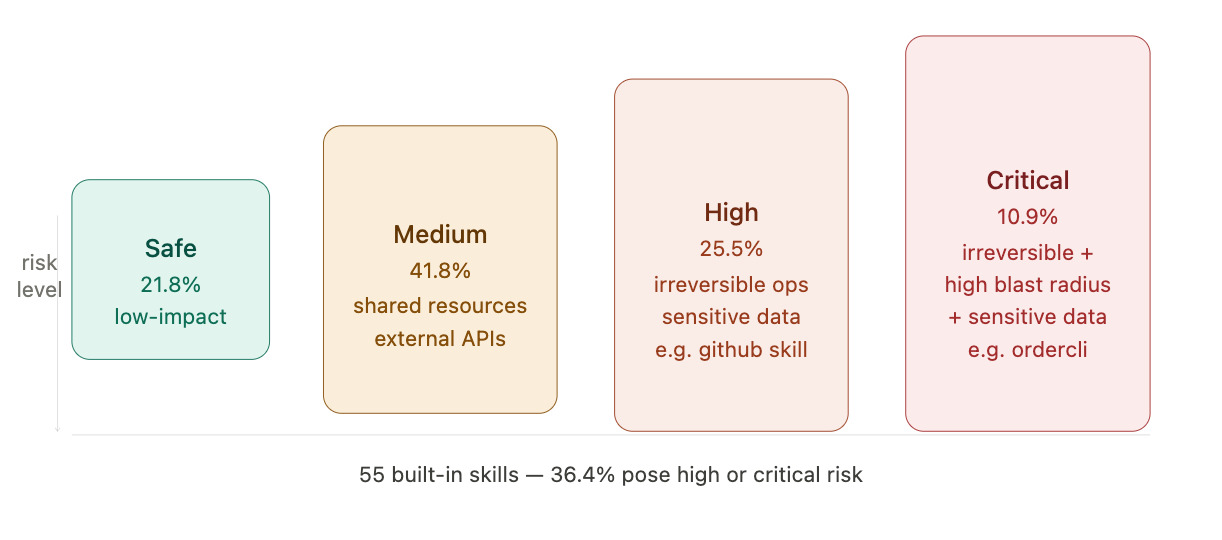
OpenClaw is built around "skills" — modular capabilities that let an AI agent perform specific tasks like drafting messages, accessing files, or running shell commands. The authors' risk analysis of OpenClaw's 55 built-in skills, classified across four dimensions:
Dimension
What it measures
Reversibility
Can the action be undone?
Blast radius
How many systems or users are affected?
Externality
Does it reach outside the local environment?
Sensitivity
Does it touch private or privileged data?
The results are stark. 36.4% of built-in skills pose high or critical safety risks — with critical skills like ordercli capable of triggering irreversible, high-impact operations over sensitive data.
Risks cluster into three recurring categories:
- Irreversible actions — deletions, external communications — that need pre-execution confirmation
- Sensitive data exposure — individually harmless skills (reading a file, sending a message) that become dangerous in combination
- Prompt injection — adversarial instructions embedded in emails, documents, or web pages that hijack the agent's reasoning
Existing defenses fall short. Static guardrails based on regex or keyword matching are brittle. The "LLM-as-a-Judge" pattern lacks consistent authority in multi-agent settings. Neither approach treats safety as an architectural invariant.
- The solution: enforcement nodes in the execution graph
SafeClaw-R's core idea is to make safety a structural property of the system rather than a layer of advice the agent can ignore.
It does this by augmenting OpenClaw's execution graph with mandatory enforcement nodes — gates that sit between the orchestrator and every functional skill. Before any action executes, it must pass through its corresponding enforcement node.
Each enforcement node is defined by a three-part specification:
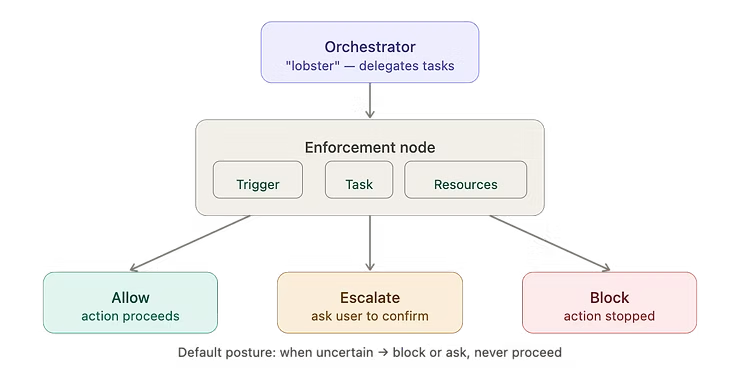
Depending on its assessment, an enforcement node can:
- ✅ Allow the action to proceed
- ❌ Block it outright
- ⏸ Escalate to the user for confirmation
The default posture is cautious: when uncertain, block or ask rather than proceed.
This creates a structural invariant: no functional action can reach execution without being mediated by its enforcement counterpart. Safety becomes mandatory — embedded in the architecture in a way that cannot be bypassed by a persuasive prompt or an unexpected reasoning chain.
- Scaling safety: the Safe Skill Factory
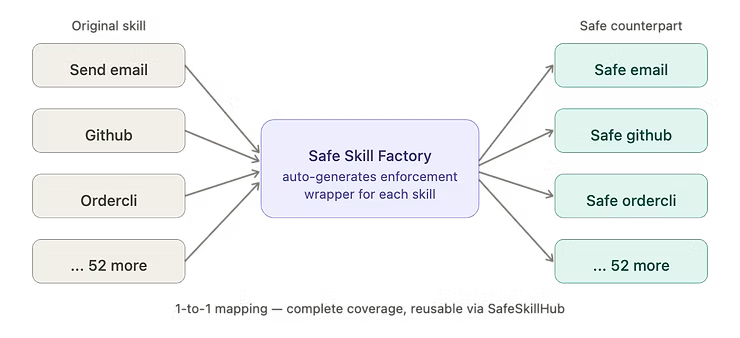
A framework requiring manually written enforcement policies for every skill wouldn't survive a fast-growing ecosystem. SafeClaw-R solves this with the Safe Skill Factory — a meta-skill that automatically synthesizes safe counterparts for existing skills.
The Factory produces a one-to-one mapping between original skills and verified safe variants, making complete coverage feasible even as the ecosystem expands.
The authors also introduce SafeSkillHub — a repository for sharing reusable safety specifications. A well-tested enforcement policy for email-sending, for example, should be reusable across any deployment, not reinvented from scratch each time.
- Evaluation: three domains, strong results
SafeClaw-R was tested across three domains spanning the major threat categories:
Domain
What was tested
Accuracy
Google Workspace
Email, calendar, documents
95.2% (vs 61.6% regex baseline)
Third-party skill ecosystems
Skill poisoning attacks
97.8% detection
Adversarial code execution
Harmful command prevention
100% detection
Crucially, the system maintains low false positive rates across all domains — because an overly cautious safety system that blocks legitimate actions will simply be turned off by frustrated users.
- What this means
SafeClaw-R arrives at a moment when the AI industry is racing to ship autonomous agents with minimal safety infrastructure.
Its core conceptual contribution: in any system where an LLM controls execution, safety must be enforced structurally. You cannot rely on the model to police itself. You need an architecture where the path from intent to action always passes through a gate that can say no.
Open questions remain — the enforcement nodes are themselves partly LLM-driven, and the one-to-one skill mapping will require ongoing maintenance as skills compose in novel ways. But as a foundational framework grounded in real-world risk analysis rather than abstract threat modeling, SafeClaw-R represents a serious contribution to a problem the industry can no longer afford to ignore.