Rethinking AI Standards: From Definition to Real-World Adoption
I recently had the opportunity to represent Singapore in the Global ICT & CET Standards Program, engaging alongside regulatory leaders from across from Brunei, Cambodia, Indonesia, Japan, Laos, Malaysia, Philippines, Vietnam, Thailand, and Timor-Leste.
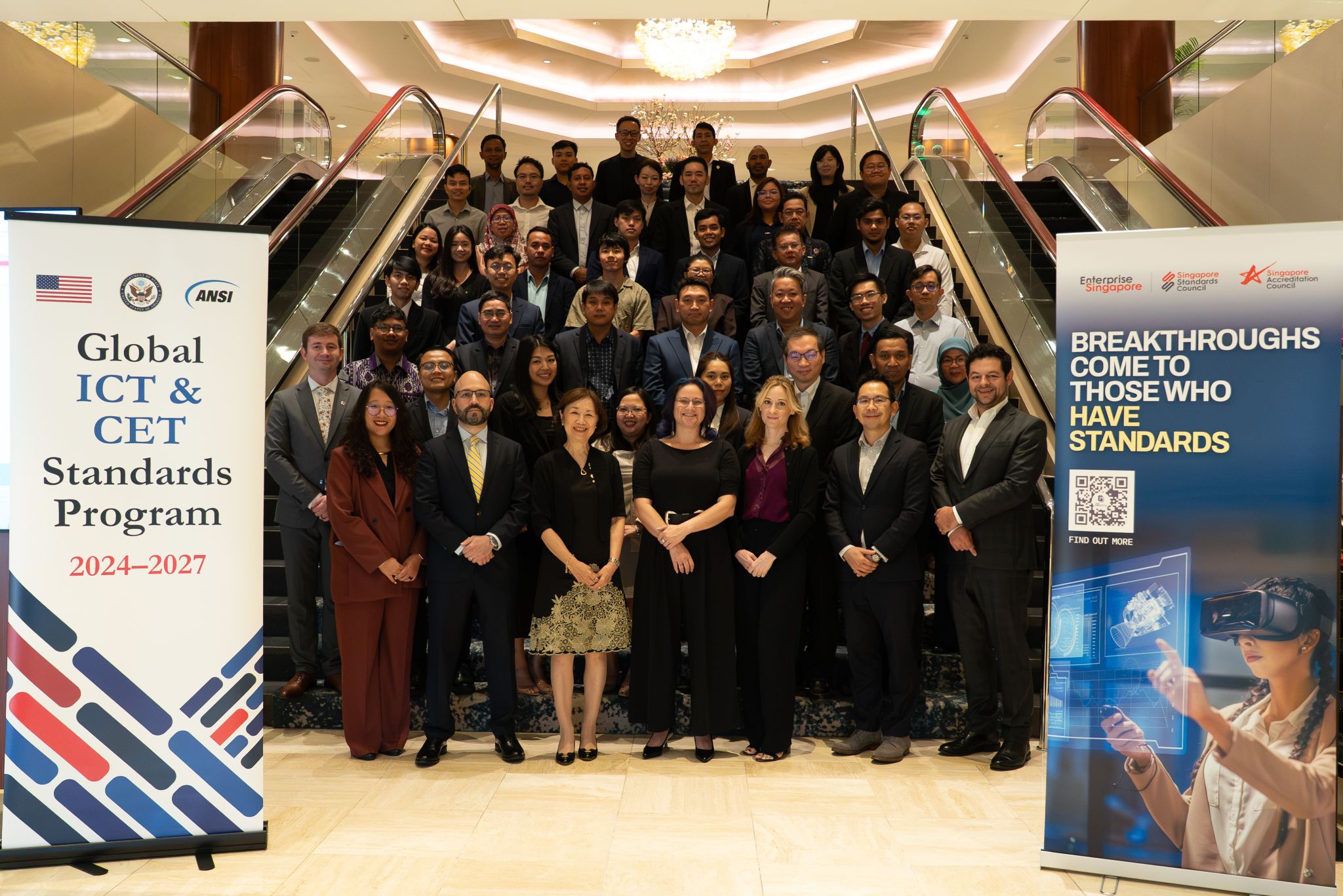
What made this experience particularly valuable was not just the discussions themselves, but the diversity of perspectives behind them. Each participant brought insights shaped by different cultural contexts, economic realities, and regulatory environments.
- Standards Are Not Neutral—They Are Context-Driven
Standards are often perceived as objective, technical artifacts. In reality, they are deeply influenced by language, economic priorities, and societal values.
Language Determines Influence
Standardization is inherently language-driven. English-speaking ecosystems dominate not only in participation but also in shaping narratives and priorities. Countries operating in less widely adopted languages face structural disadvantages.
For example, participants from Brunei highlighted the imbalance in access to standardization resources—both in terms of language and available expertise. This creates barriers not only in adopting standards, but even in engaging with them meaningfully.
Development Stage Determines Timing
A more subtle but critical insight is this: standards are not universally applicable at all times.
In discussions with representatives from Cambodia, the challenge was not resistance to standards, but capacity—particularly the lack of AI talent and limited representation in international standard bodies such as ISO/IEC JTC 1/SC 42. Without sufficient local expertise and participation, contributing to or even interpreting standards becomes difficult.
This reinforces that standard adoption must align with development stage—not just technically, but institutionally.
Culture Shapes Adoption
Beyond language and capability, culture also plays a critical role.
A representative from Vietnam highlighted that differences in organizational culture and decision-making styles can significantly influence how standards are interpreted and implemented. What may be considered “best practice” in one context may not translate directly into another.
This highlights a deeper point: standards do not operate in isolation—they interact with existing systems of behavior, incentives, and governance.
- The Core Challenge: Adoption, Not Design
Most discussions around standards focus on design—how to define principles, frameworks, and requirements.
But in practice, the real bottleneck is adoption.
- Overly detailed standards increase compliance cost and reduce flexibility
- Overly abstract standards fail to guide real-world implementation
Effective standards are not those that are most comprehensive, but those that are most usable under real constraints.
At their core, standards are not theoretical consensus—they are operational agreements that must survive real-world complexity.
- AI****Is Breaking the Standardization Model
AI fundamentally challenges how standards are created and applied.
Speed Mismatch
Traditional standardization operates on a multi-year cycle, while AI evolves in months.
This creates a structural lag:
- standards risk being outdated upon release
- organizations increasingly rely on internal governance mechanisms
In this environment, testing and assurance are becoming de facto standards, translating abstract principles into measurable and enforceable practices.
Adoption Over Innovation
Across ASEAN, the priority is often not developing AI, but deploying AI effectively and safely.
This shifts the problem space:
- from innovation → to trust
- from capability → to risk management
The key challenges are:
- building confidence in AI systems
- establishing systematic, repeatable approaches to mitigate risks
Responsibility Tracing: The Missing Layer
A growing and often under-addressed challenge is responsibility tracing.
When an AI system fails, the question is no longer purely technical—it becomes institutional:
- Is the model developer responsible?
- The system integrator?
- The data provider?
- The deploying organization?
- Or the end user?
In modern AI systems—especially those involving APIs, third-party models, and complex pipelines—responsibility is inherently distributed.
This creates a critical gap:
standards can define what should be done, but often fail to define who is accountable when things go wrong.
Without clear responsibility mapping:
- risk governance becomes ambiguous
- compliance becomes difficult to enforce
- trust in AI systems erodes
- Singapore Perspective: From Principles to Quantification
From a Singapore perspective, one priority stands out clearly: AI safety and testing are becoming the central focus of AI governance.
The challenge is no longer just defining principles such as fairness, robustness, or transparency—but quantifying and evaluating them in a consistent and scalable way.
This raises a critical question:
How do we move from qualitative principles to quantitative, measurable assurance?
Without quantification:
- standards remain interpretative
- compliance becomes subjective
- trust cannot be systematically validated
This is where evaluation frameworks, benchmarking, and systematic testing become essential—not as supporting tools, but as core infrastructure for AI governance.
In this context, platforms like AIDX focus specifically on this gap—translating high-level AI governance principles into measurable testing methodologies and evaluation metrics. By enabling systematic assessment of AI risks and performance, such approaches help move standards from conceptual alignment to practical, evidence-based assurance.
- Why GlobalStandardsStruggle
Not all standards face the same level of difficulty.
- International standards require alignment across cultures, political systems, and value frameworks
- National standards must bridge multiple industries and use cases
- Industry and enterprise standards operate within more defined contexts and incentives
This leads to a practical reality:
Standardization does not scale top-down. It evolves bottom-up.
Enterprise → Industry → National → International
- Moving Forward: Making Standards Work
If the real challenge is operationalization, then contributing to standards requires a shift in approach.
1. Start with Frameworks, Then Operationalize
Instead of aiming for rigid standards upfront, start with adaptable frameworks. Test them in real environments, and evolve them into practical, implementable guidelines.
2. Translate Standards into Practice
Standards need to be executable, not just readable.
This requires:
- case studies grounded in real deployments
- implementation handbooks and playbooks
Without this layer, standards remain theoretical.
3. Build the Next Generation of Contributors
Standardization must move beyond expert circles.
Embedding it into university education can:
- create early exposure
- build long-term capacity
- connect research with governance and industry practice
4. Rethink How Standards Are Communicated
Standards today suffer from a visibility problem.
To scale adoption:
- simplify communication through visual and short-form content
- leverage social media to reach beyond expert communities
Accessibility is a prerequisite for adoption.
5. Align Incentives with Contribution
A structural issue remains: contributing to standards is often undervalued.
To change this, standardization should be:
- recognized in career progression and promotions
- counted as academic and research output
- embedded in performance evaluation systems
Without aligning incentives, participation will remain limited—and progress will be slow.
- Final****Thought
Standardization is often framed as a technical exercise.
In reality, it is a coordination challenge across systems that differ in capability, priorities, and context—and increasingly, in how responsibility is assigned and enforced.
The success of a standard is not determined by how well it is written, but by how effectively it can be implemented—and measured—across contexts.
And in the age of AI, operationalization, quantification, and accountability are no longer extensions of standards—they are the standard itself.