Safeguarding Requirements for OpenClaw: Building a Safety Layer for Multi-Agent Systems
OpenClaw represents a new generation of intelligent systems built from modular "skills," where each skill performs a specific task such as sending messages, accessing data, or interacting with external services. This modular design makes the system powerful and flexible, but it also introduces new safety challenges. Most existing skills are designed to accomplish tasks efficiently, not to consider whether those tasks are safe, appropriate, or potentially harmful.
To ensure that OpenClaw operates reliably and responsibly, it is necessary to introduce a dedicated safety layer that works alongside these skills. This safety layer should systematically identify risks, ensure that every skill is properly governed, and enforce safeguards during operation. Below, we outline three key challenges and the corresponding requirements for building such a system.
1. Understanding and Analyzing Safety Risks
The first step toward safeguarding OpenClaw is to clearly understand what could go wrong. Because the system is made up of many independent skills, risks can arise not only from individual actions but also from how different skills interact with one another.
Some risks are straightforward. For example, a skill that deletes files or sends emails could cause harm if triggered incorrectly. Other risks are less obvious. A skill that reads sensitive information may seem harmless on its own, but when combined with another skill that sends messages externally, it could lead to unintended data leaks. In addition, because OpenClaw often processes natural language instructions, it may be vulnerable to misleading or malicious inputs that trick the system into taking unsafe actions.
To address this, OpenClaw needs a structured way to analyze risks across all skills. This involves identifying different types of potentially harmful actions, such as irreversible operations, access to sensitive information, large-scale changes, or interactions with external parties. Each skill should be examined and labeled according to the kinds of risks it may pose.
Importantly, this analysis should not only consider what a skill is intended to do, but also how it might be misused or combined with other skills. By building a comprehensive understanding of these risks, OpenClaw can form a strong foundation for designing effective safeguards.
2. Ensuring Every Skill is Protected

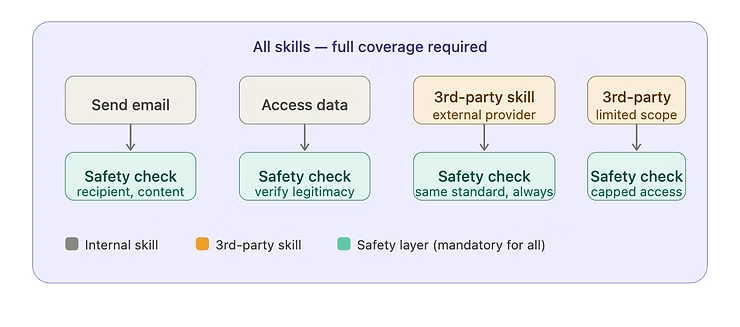
Once risks are identified, the next challenge is to ensure that every skill in the system is properly protected. A key requirement is that no skill should operate without some form of safety oversight.
This means that each skill must be paired with a corresponding safety layer that evaluates whether it is appropriate to carry out a given action. For example, before sending an email, the system might check whether the recipient is correct, whether the content is sensitive, or whether the user intended the action. Similarly, before accessing or sharing data, the system should verify that the request is legitimate and within acceptable boundaries.
The goal is to achieve full safety coverage across the system. In other words, every action — no matter how small or routine — should pass through a safety check before being executed. This ensures that risks are consistently managed, rather than addressed in an ad hoc or incomplete manner.
Another important consideration is the growing ecosystem of third-party skills. OpenClaw may integrate skills developed by external providers, which may not follow the same safety standards. To handle this, the system must enforce consistent safety requirements for all skills, regardless of their origin. External skills should be carefully reviewed, limited in their capabilities if necessary, and always subject to the same safety checks as internal ones.
3. Enforcing Safety During Operation

Identifying risks and defining safety rules is not enough on its own — the system must also ensure that these rules are actually followed during operation. This is where enforcement becomes critical.
In OpenClaw, safety should be built directly into how actions are carried out. Before any skill performs its task, the system should first evaluate whether the action is safe. Depending on the situation, the system may allow the action to proceed, block it entirely, or ask the user for confirmation. For example, if an action could have significant consequences — such as sending information outside the organization — the system might pause and request explicit approval.
In addition to checking actions beforehand, OpenClaw should also monitor what happens during and after execution. This allows the system to detect unexpected behavior, stop actions if necessary, and keep records for accountability. Such monitoring helps ensure that safety is maintained not just at the start, but throughout the entire process.
User involvement is another key aspect of enforcement. For high-risk actions, users should be kept informed and given the opportunity to make decisions. This not only reduces the likelihood of mistakes but also builds trust in the system by making its behavior more transparent.
Finally, the system should be designed to err on the side of caution. If there is uncertainty about whether an action is safe, the default response should be to pause, block, or seek clarification rather than proceed blindly. This "fail-safe" approach is essential for preventing unintended harm.
4. Guiding Principles for a Safe System

To effectively safeguard OpenClaw, several overarching principles should guide the design of the safety layer:
- Complete coverage: Every skill must be subject to safety checks, with no exceptions.
- Consistency: Safety rules should be applied uniformly across all skills and scenarios.
- Awareness of context: Decisions should consider the situation, not just the action itself.
- User control: Users should remain informed and involved, especially for important actions.
- Flexibility: The system should be able to adapt as new skills and risks emerge.
- Accountability: Actions and decisions should be traceable for review and improvement.
5. Summary

As OpenClaw continues to grow in capability and complexity, ensuring its safe operation becomes increasingly important. The introduction of a dedicated safety layer is essential to address the risks associated with modular, autonomous systems.
This requires a comprehensive understanding of potential threats, a commitment to protecting every skill with appropriate safeguards, and strong enforcement mechanisms that ensure safety rules are consistently followed. By embedding safety into every stage of operation — from planning to execution — OpenClaw can evolve into a system that is not only powerful but also reliable, responsible, and trustworthy.
Ultimately, the goal is not to limit what the system can do, but to ensure that it acts in ways that align with user intent, respect boundaries, and avoid unintended harm.